Homo neanderthalensis Bibliographia | Nexus interni Nexus externi | Tabula navigationisNasal airflow simulations suggest convergent adaptation in Neanderthals and modern humansPaginae selectaeNeanderthal self-medication in contextU-Th dating of carbonate crusts reveals Neandertal origin of Iberian cave artEvidence for precision grasping in Neandertal daily activitiesExternal ballistics of Pleistocene hand-thrown spears: experimental performance data and implications for human evolutionEpitomeEpitomeIn Neanderthal DNA, Signs of a Mysterious Human MigrationBiodiversityEncyclopedia of LifeFossilworksINPN France
Species animaliumHomo neanderthalensisTaxa KingTaxa 1863
King1863Valle NeanderthalensiGermaniaspeciessubspeciesgenerisfamiliaeHominidarumlitterisscientificisvallisNeandriDusseldorpium1866ossiumcerebroossiumBelgia1829CalpaeEuropaeaAsiaticaexstinctaAsiaEuropa
 -2 Latinitas huius rei dubia est. Corrige si potes. Vide latinitas.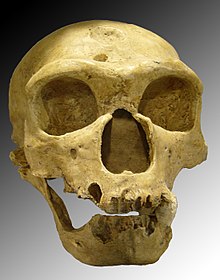
Caput Neanderthalense e Chapelle-aux-Saints Franciae
Homo neanderthalensis (King anno 1863), ex Valle Neanderthalensi in Germania appellatus, fuit species vel subspecies generis Hominis familiae Hominidarum. In litteris scientificis etiam nominatur.
Nomen neanderthalensis nascitur ex nomine vallis Neandri prope Dusseldorpium, ubi, anno 1866, reliquiae hominis detectae sunt, ossium similes hominum hodiernorum, sed cerebro maiore (1650 centimetris cubicis), fronte recedente, habituque omnino robustiore.
Partes ossium compages Hominis neanderthalensis in Belgia primum detectae sunt anno 1829, iterum Calpae.
Homo neanderthalensis est species Europaea et Asiatica. Antiquissima ossium compages sunt circa duocentum decies centum milia annorum antiqui. Species exstincta est abhinc plusquam annorum 50 milia in Asia et 30 milia in Europa.
Putatur Homo neanderthalensis ex Homine erecto aut Homine heidelbergensi ortum esse.
Bibliographia |
- S. de Azevedo et al., "Nasal airflow simulations suggest convergent adaptation in Neanderthals and modern humans" in Proceedings of the National Academy of Sciences (30 Octobris 2017)
- Nicholas J. Conard, Jürgen Richter, edd., Neanderthal Lifeways, Subsistence and Technology: One Hundred Fifty Years of Neanderthal Study. Berolini: Springer, 2011. ISBN 9789400704152 (Paginae selectae apud Google Books)
- Karen Hardy, Stephen Buckley, Michael Huffman, "Neanderthal self-medication in context" in Antiquity vol. 87 no. 337 (2013) pp. 873-878
- D. L. Hoffmann et al., "U-Th dating of carbonate crusts reveals Neandertal origin of Iberian cave art" in Science vol. 359 (2018) pp. 912-915
- Fotios Alexandros Karakostis, "Evidence for precision grasping in Neandertal daily activities" in Science: Advances vol. 4 no. 9 (26 Septembris 2018)
- Annemieke Milks, David Parker, Matt Pope, "External ballistics of Pleistocene hand-thrown spears: experimental performance data and implications for human evolution" in Nature Scientific Reports vol. 9 no. 820 (25 Ianuarii 2019)
- Marylène Patou-Mathis, "Neanderthal subsistence behaviors in Europe" in International Journal of Osteoarchaeology vol. 10 (2000) pp. 379-395 Epitome
- Mary C. Stiner, Honor Among Thieves: A Zooarchaeological Study of Neandertal Ecology. Princetoniae: Princeton University Press, 1994
- Fernando A. Villanea, Joshua G. Schraiber, "Multiple episodes of interbreeding between Neanderthal and modern humans" in Nature Ecology & Evolution (26 Novembris 2018) Epitome
- Carl Zimmer, "In Neanderthal DNA, Signs of a Mysterious Human Migration" in New York Times (4 Iulii 2017)
Nexus interni
- Peștera cu Oase
- Spelunca Amud
- Spelunca Kebara
Nexus externi |
 | Vicimedia Communia plura habent quae ad Homo neanderthalensis spectant. |
 | Vide Homo neanderthalensis apud Vicispecies. |
 | Situs scientifici: • Biodiversity • Encyclopedia of Life • Fossilworks • INPN France |


